Real-time integration for warehouse automation and IIoT

Connect WMS, robots, sensors, and edge nodes in real time.

Routic is the reliable event and telemetry backbone for distributed operations. Move commands, statuses, productivity signals, and sensor streams between WMS, WCS, FMS, robotics systems, and industrial edge infrastructure with in-sequence, at-least-once delivery.

Built for distributed operational systems.

Routic focuses on the part other platforms often blur together. It does not need to own BPMN or business process design to be critical. It owns the reliable movement of operational events, commands, and telemetry between systems that must stay aligned while the physical world keeps moving.

Reliable real-time delivery

Preserve ordering where it matters. Retry safely when links fail. Keep commands and status messages moving across site boundaries, network interruptions, and heterogeneous software stacks.

GuaranteesIn-sequence, at-least-once delivery
InterfacesWebSocket, APIs, edge connectors, event streams
ScopeSingle site, multi-site, cloud, private cloud
One platform for execution and telemetry

Use the same backbone for operational workflows and sensor capture. Route WMS events to automation software, then capture productivity and IIoT telemetry into a centralized time-series layer for analytics and visibility.

Execution
WMS WCS FMS Robotics
Telemetry
RF scans Employee productivity OPC UA MQTT sensors
Persistence
Timeseries DB Data platform Operational dashboards

Designed around high-value scenarios.

Routic fits the integration gaps that appear once warehouse automation becomes distributed. The same platform can serve execution traffic between control systems and high-volume telemetry flowing from edge devices into central observability and analytics infrastructure.

WMS ↔ WCS

Synchronize tasks, exceptions, lane statuses, and routing updates across conveyors, sortation, AS/RS, and workstations.

WMS ↔ FMS

Move missions, acknowledgements, battery and traffic states, and completion events between warehouse software and AMR or AGV fleets.

WMS ↔ Robotics

Coordinate robotic picking, pallet movement, and workstation execution with low-friction event exchange and resilient state delivery.

Employee productivity capture

Collect activity from WMS transactions, RF scans, operator interactions, station events, and automation signals. Build a live picture of picks per hour, active time, idle time, exception concentration, and zone congestion without hardwiring every downstream consumer to every source.

Signalspick, put-away, pack, scan, task accept, task complete
Contextworker, zone, shift, workstation, order type
Outputsdashboards, alerts, labor analytics, historical reporting

Distributed IIoT ingestion

Run edge nodes close to the equipment. Aggregate thousands of local connections, normalize protocols, buffer locally when links fail, and forward telemetry to a centralized cloud or private-cloud node that writes to time-series storage.

SourcesOPC UA, MQTT, PLC-adjacent gateways, sensors
Edge roleprotocol handling, buffering, filtering, site isolation
Central rolecross-site visibility, retention, analytics, governance

Edge at the site. Control in the center.

Deploy Routic in a distributed topology that keeps local operations responsive while creating a unified operational record across sites. Use edge nodes for acquisition and resilience, then centralize normalized events and telemetry for analysis, monitoring, and downstream consumption.

Edge

Terminate device and system connections close to the operation.

Core

Centralize visibility, policy, and persistence in cloud or private cloud.

Time

Capture live streams and preserve history in time-series storage.

Order

Keep event flow reliable when physical execution depends on state.

Visual integration that everyone can follow.

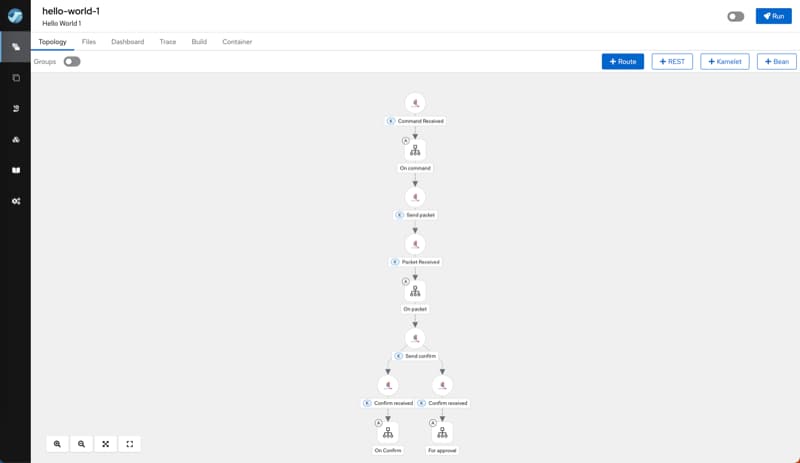
The power of visual integration is that engineers and product owners can author and understand the same flow. Routic uses Camel Karavan to visually design inbound integrations that capture commands and events from systems like WMS, and outbound integrations that invoke targets such as databases, PLC-facing services, MQTT brokers, and time-series pipelines.

Author integrations visually, then run them operationally

Design routes as something both technical and operational teams can read. That makes it easier to review how events enter Routic, how they are transformed, and where they are published next across execution systems and telemetry targets.

InboundCapture event and command data from WMS, scanners, APIs, and edge sources
OutboundInvoke databases, PLC-facing services, MQTT topics, and time-series writers
Shared understandingEngineers build faster while product owners can still inspect the flow logic
Apache Camel Karavan visual route designer showing connected integration steps

Camel Karavan in action

Use a visual route designer for enterprise integration patterns, components, and route topology so integrations are easier to build, review, and maintain.

Screenshot shown from Apache Camel Karavan.

Why Routic

Stop forcing warehouse execution traffic and industrial telemetry through brittle point-to-point integrations.

For operatorsFaster visibility into what is happening now
For engineersOne backbone for distributed events and data capture
For product teamsA sharper category than generic orchestration

Real-time integration for distributed operations.

Routic connects execution systems, productivity signals, and IIoT telemetry across warehouses and industrial environments.